
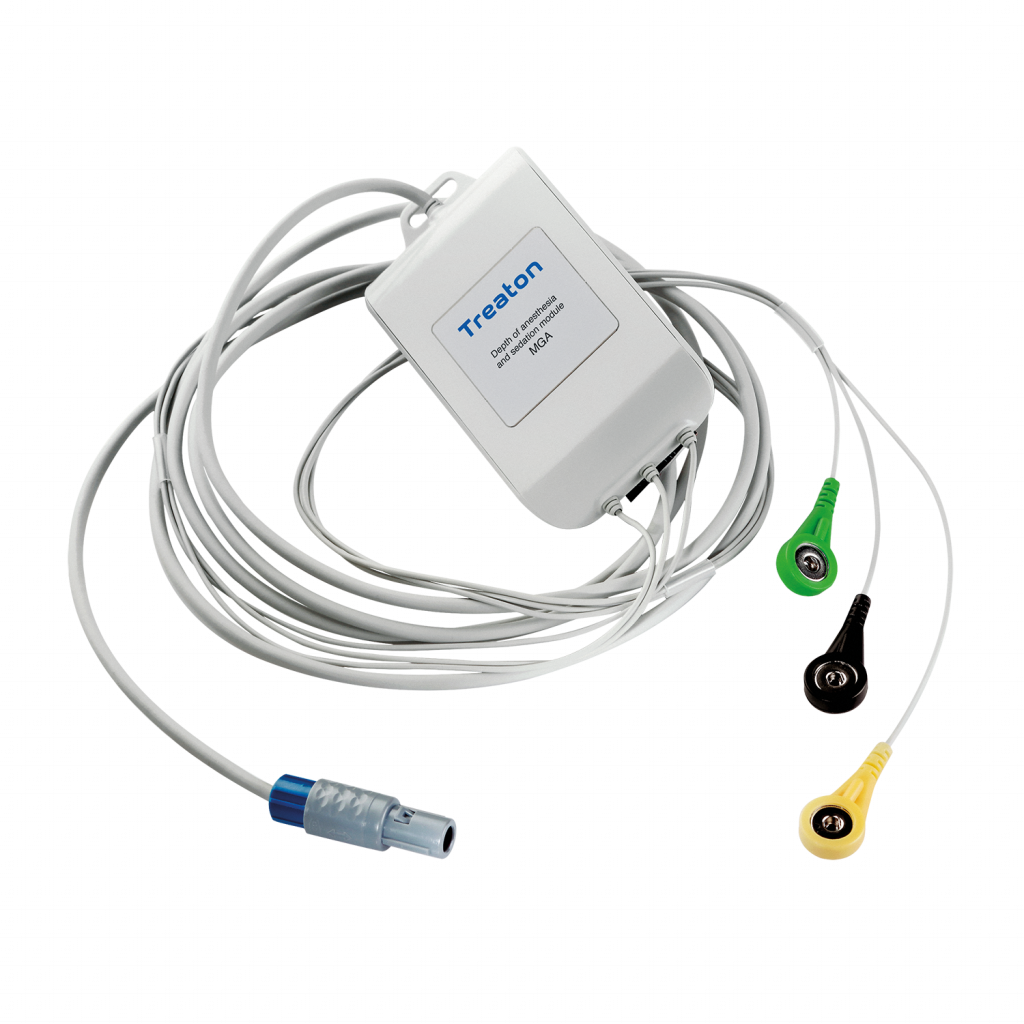
This is the solution for the daily routine depth of anesthesia monitoring, a standard monitoring tool in a medical institution, thereby increasing the patient’s safety and quality of patient care. Depth of Anesthesia and Sedation Module can be connected to the monitoring host device and transfers parameters of the Brain Activity Index, Signal Quantity Index, Electromiographic Component.
Identified Parameters
AI
|
Brain Activity Index
|
Indicates the level of consciousness depression by analyzing EEG, taking into account information on typical signs of anesthetics’ impact on patients
|
SQI
|
EEG Signal Quality Index
|
Reflects noise influence on EEG signal
|
EMG
|
Electromyographic Component Level
|
Indicates the level of electrical activity of facial muscles
|
|
Z1, Z2, Z3
|
Electrode impedance
|
Demonstrates the quality of electrodes application and electrodes’ electric contact with the patients’ skin
|
Interpreting AI (Brain Activity Index) Data
AI value
|
Clinical stages of anesthesia
|
Clinical signs
|
90–100
|
Awake
|
80–90
|
Anesthesia stage I — light sedation
|
Incomplete awakening, patient opens eyes and maintains visual contact in response to a voice for 10 seconds or less
|
60–80
|
Anesthesia stage II — sedation
|
Patient moves and opens eyes in reaction to voice but does not fix the eyes — no visual contact or no response to voice but eye movements and eye opening after a physical stimulation persists
|
40–60
|
Anesthesia stage III — surgical state
|
No response to voice or physical irritants
|
30–40
|
Anesthesia stage IV — deep anesthesia, BS (burst–suppression) patterns emerge
|
20–30
|
Anesthesia stage V — deeper anesthesia compared to stage IV, length of suppression episodes may reach 10 seconds
|
0–10
|
Anesthesia stage VII — extremely deep anesthesia, suppression episodes constitute 75% and more of the whole signal duration
|
 This is the solution for the daily routine depth of anesthesia monitoring, a standard monitoring tool in a medical institution, thereby increasing the patient’s safety and quality of patient care. Depth of Anesthesia and Sedation Module can be connected to the monitoring host device and transfers parameters of the Brain Activity Index, Signal Quantity Index, Electromiographic Component.